
Air Quality
An Assessment of Personal Exposure of a High-Risk Occupational Group to Fine Particulate Pollution in Metro Manila, Philippines

TOOLKIT / TOOLS / CLIMATE / Air Quality
This study focused on quantifying the spatial and temporal distribution of jeepney drivers’ exposure levels to respirable fine particulate pollution in Katipunan, Quezon City.
Metro Manila, Philippines is one of the megacities in Southeast Asia that has PM2.5 concentrations higher than guideline values, with the public utility jeepney (PUJ) as one of the identified sources contributing to fine particulate pollution in the city. The PUJ is the cheapest and most popular mode of transportation. Jeepney drivers, a high-risk occupational group, ply their routes for 10 to 12 hours a day, exposing them to high levels of particulate pollution. Thus, a series of field measurements was carried out for five weeks from November to December 2018 along the UP Campus – Katipunan jeepney route to characterize the spatial and temporal distribution of fine particulate pollution, and to estimate the personal exposure of the jeepney drivers to PM2.5.
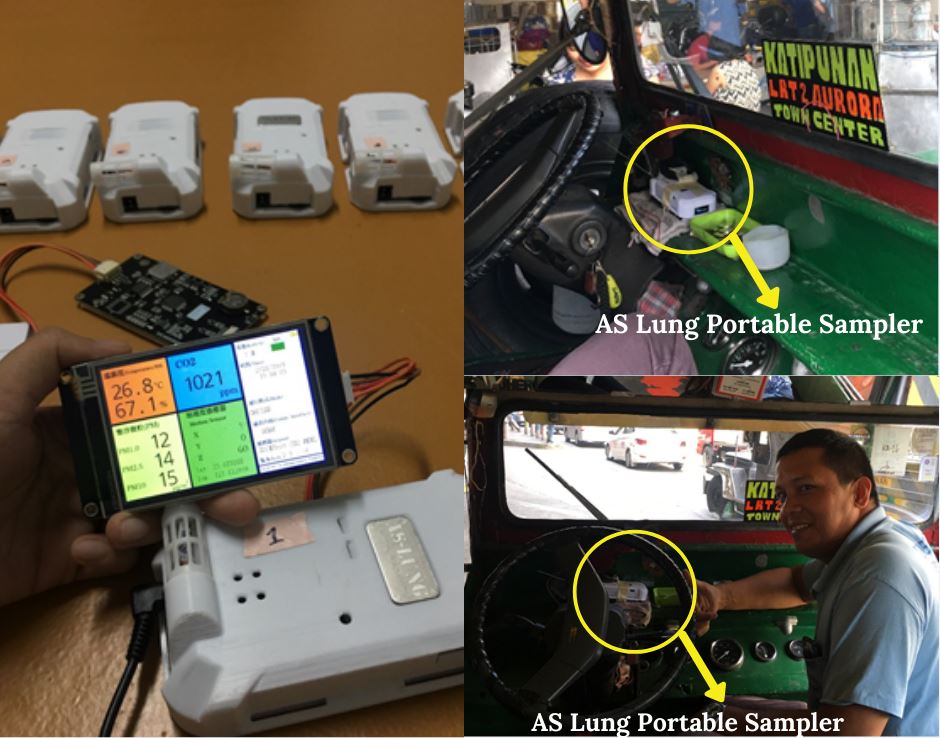
Real-time PM2.5 personal exposure levels of 31 drivers plying a fixed 8 km route were recorded continuously for 10-12 hours each sampling from November 12 to December 15, 2018, yielding a total of 1061 complete circuits. Sampling results showed that the mean PM2.5 exposure concentration for all runs was 38 μg m-3, about a factor of four greater than the mean annual PM2.5 guideline value (10 μg m-3) set by the World Health Organization. Elevated levels of PM2.5 (hotspots) were also identified for the designated route, and these were consistently observed at intersections and across a shopping mall. The AS Lung Portable Samplers were attached to the jeepney dashboard within the driver’s breathing zone. Lower right: With Mr. Joe Ann Mendoza of the Katipunan-KMart Jeepney Operators and Drivers Association (KKJODA)
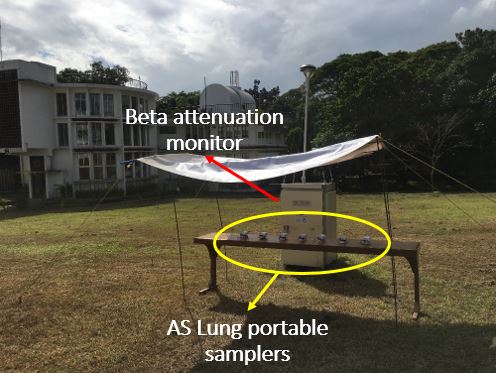
To ascertain the accuracy of field measurements, the seven portable PM2.5 samplers used in the study were collocated with a Beta Attenuation Monitor (BAM) for 16 days (N = 368, mean number of sampling points), showing strong linear relationship with the BAM for all seven sensors (R2 = 0.83 to 0.85). The seven AS Lung Portable Samplers were set up to take outdoor side-by-side measurements with the Beta Attenuation Monitor (BAM).
The results of this study will provide valuable information on the PM2.5 exposure of this occupational group that is most exposed to particulate pollution, as well as the identification of locations of transport microenvironments that have very high fine particulate pollution. Furthermore, the results of this study will offer quantitative evidence that is much needed by the government’s Public Utility Vehicle Modernization Plan (PUVMP), a policy program that aims to replace old jeepneys with a more eco-friendly version that produces fewer particulate matter emissions.
Manila Observatory’s Resilience Collaboratory
The Resilience Collaboratory runs activities and programs that aim to strengthen the resilience capacities of communities that are exposed to frequent hazards, to address local vulnerabilities, and to support efforts to adapt to disaster risks and climate impacts. The Resilience Collaboratory facilitates collaboration among the core laboratories of the Manila Observatory with a shared goal of delivering useful and usable climate and disaster risk information to the most vulnerable, and initiates transdisciplinary partnerships with various institutions outside academia especially civil society organizations, and the public and private sectors.
For more information about the Resilience Collaboratory, visit the Manila Observatory website.
RELATED STUDIES
Climate Projections 🔗 | Characterizing climate-related and atmospheric hazards, vulnerability and risk across space and time.
Health 🔗 | Assessing and Projecting Climate-Related Infectious Diseases in Quezon City.
Social Vulnerability 🔗 From the Skies to the Streets: An Ethnography of Street-based Populations in Metro Manila, Philippines, and Local Knowledge Systems Regarding Environmental Pollution and Climate Disaster Risks
RELATED SITES
Climate and Disaster Resilience Laboratory →
Department of Environmental Science →
RELATED STORIES
Dr. Cambaliza in the SRI (Sustainability Research & Innovation) Congress 2021
Tackle Air Quality and Human Health with New Thinking and Technologies 🔗 Read More
RESEARCH TEAM

DR. MARIA OBIMINDA L. CAMBALIZA
Research Scientist, Air Quality Dynamics Instrumentation and Technology Development Laboratory, Manila Observatory
MS. MELLIZA T. CRUZ
Research Associate, Air Quality Dynamics and Instrumentation and Technology Development Laboratory, Manila Observatory
DR. JAMES BERNARD B. SIMPAS
Laboratory Head, Air Quality Dynamics and Instrumentation and Technology Development Laboratory, Manila Observatory
DR. JOHN WONG
Associate Professor, Department of Health Sciences, Ateneo de Manila University
DR. CHARLOTTE KENDRA GOTANGCO GONZALES
Associate Professor, Department of Environmental Science, Ateneo de Manila University
MS. IMEE DELOS REYES
Former Graduate Student, Department of Physics, Ateneo de Manila University
MS. GABRIELLE FRANCES LEUNG
Former Research Assistant, Air Quality Dynamics and Instrumentation and Technology Development Laboratory, Manila Observatory
MS. KATRINA ABENOJAR
Former Research Assistant, Department of Environmental Science, Ateneo de Manila University
MR. CARLOS MANALO
Former Research Assistant, Department of Environmental Science, Ateneo de Manila University
MS. PAOLA ANGELA BAÑAGA
Former Research Assistant, Coastal Cities at Risk in the Philippines (CCARPH)
MR. BERNELL GO
Former Research Assistant, Air Quality Dynamics and Instrumentation and Technology Development Laboratory, Manila Observatory
MS. CHRISTINE LO CHAN
Research Assistant, Air Quality Dynamics and Instrumentation and Technology Development Laboratory, Manila Observatory
MS. GRACE BETITO
Research Assistant, Air Quality Dynamics and Instrumentation and Technology Development Laboratory, Manila Observatory
MR. JARL TYNAN COLLADO
Research Assistant, Air Quality Dynamics and Instrumentation and Technology Development Laboratory, Manila Observatory
MR. JOSE GABRIEL F. ABALOS
Research Assistant, Air Quality Dynamics and Instrumentation and Technology Development Laboratory, Manila Observatory
 COASTAL CITIES AT RISK IN THE PHILIPPINES
Leave a comment